Applying for Technical Project Manager

The PM who ships
and writes the software.

Twenty years of delivery. Twelve of Agile leadership. A GitHub full of production-deployed code. Here's why that matters to your CTO.

Richard J. Valeo, CSM  ·  Georgetown, CO (Remote, U.S.)  ·  917-664-1750  ·  rjvaleo@gmail.com
Scroll
01 — The Signal

What the job asks for.
What I actually have.

Click any row. This is an honest audit against the job description.

What DriveCentric needs What I bring
5+ years managing software development projects
20+ years. Agile, Waterfall, hybrid — matched to the project, not the methodology religion.
Eptura (enterprise SaaS, ~10 distributed teams), A&E Television Networks (12–15 concurrent SVOD release streams), Understood.org (distressed replatform rescue), Paperless Post (iOS + mobile web), DigitasLBI/SunTrust (SAFe, regulated financial services). All CTO- or VP-adjacent delivery roles.
3+ years with Senior Leadership and Product Owners on short- and long-term goals
Every role. Roadmap planning, quarterly prioritization, change impact analysis, tradeoff framing — not just attending the meetings, running them.
At Eptura: weekly and monthly leadership reporting with decision-ready delivery health, risk, and scope tradeoff options. At Understood.org: primary POC for executive stakeholders through a high-risk multi-year replatform. At the stealth AI startup: translated ambiguous stakeholder goals into sprint-ready backlogs and measurable KPIs, reported to senior stakeholders weekly.
Critical path · cross-team coordination · dependency management
This is the job. Dependency mapping, sequencing, surfacing conflicts before they become incidents.
At Eptura: introduced dependency mapping that surfaced cross-team conflicts multiple sprints earlier, reducing mid-sprint re-planning events by 35%+. At A&E: coordinated 12–15 concurrent release streams. Scrum-of-Scrums facilitation is a consistent pattern across my last four engagements.
Active blocker identification and resolution
Proactive, not reactive. Blockers get surfaced in planning, not in standups.
At the stealth AI startup: daily war rooms reduced data processing bottlenecks ~30%. At Paperless Post: DoR coaching cut mid-sprint churn significantly. The pattern: diagnose the system producing the blocker, not just the blocker itself.
Jira and Confluence — usage and administration
Not just a user. I configure workflows, design dashboards, and build the visibility layer the org runs on.
At Eptura: standardized Jira workflows, custom fields, and dashboards across a 30+ person engineering and product org. At A&E: transitioned teams from ad-hoc tracking to structured Jira-based execution from scratch. At Paperless Post: standardized Confluence documentation and sprint reporting. This is a repeating pattern, not a one-time effort.
Story point estimation · velocity monitoring · course correction
Velocity data is only useful if you know what's causing it. I track the signal, not just the number.
Burndown, velocity trends, cycle time, lead time, spillover, carryover rates — tracked and acted on, not just reported. At the stealth AI startup: re-sequenced delivery pipelines when throughput metrics signaled risk. Estimation coaching is part of backlog readiness practice in every engagement.
Integration partner primary POC
External-facing delivery ownership. Scope, timelines, technical handoffs, escalation paths — all owned.
At Understood.org: primary POC for engineering leadership, executive stakeholders, and data/analytics partners. At DigitasLBI/SunTrust: coordinated with offshore QA in Costa Rica in a compliance-aware financial services environment. At Underline Communications: managed third-party partner deliverables across a 16-week SaaS build.
Hands-on software development experience (plus)
Currently shipping. Not "I used to code." Active GitHub practice with production-deployed applications.
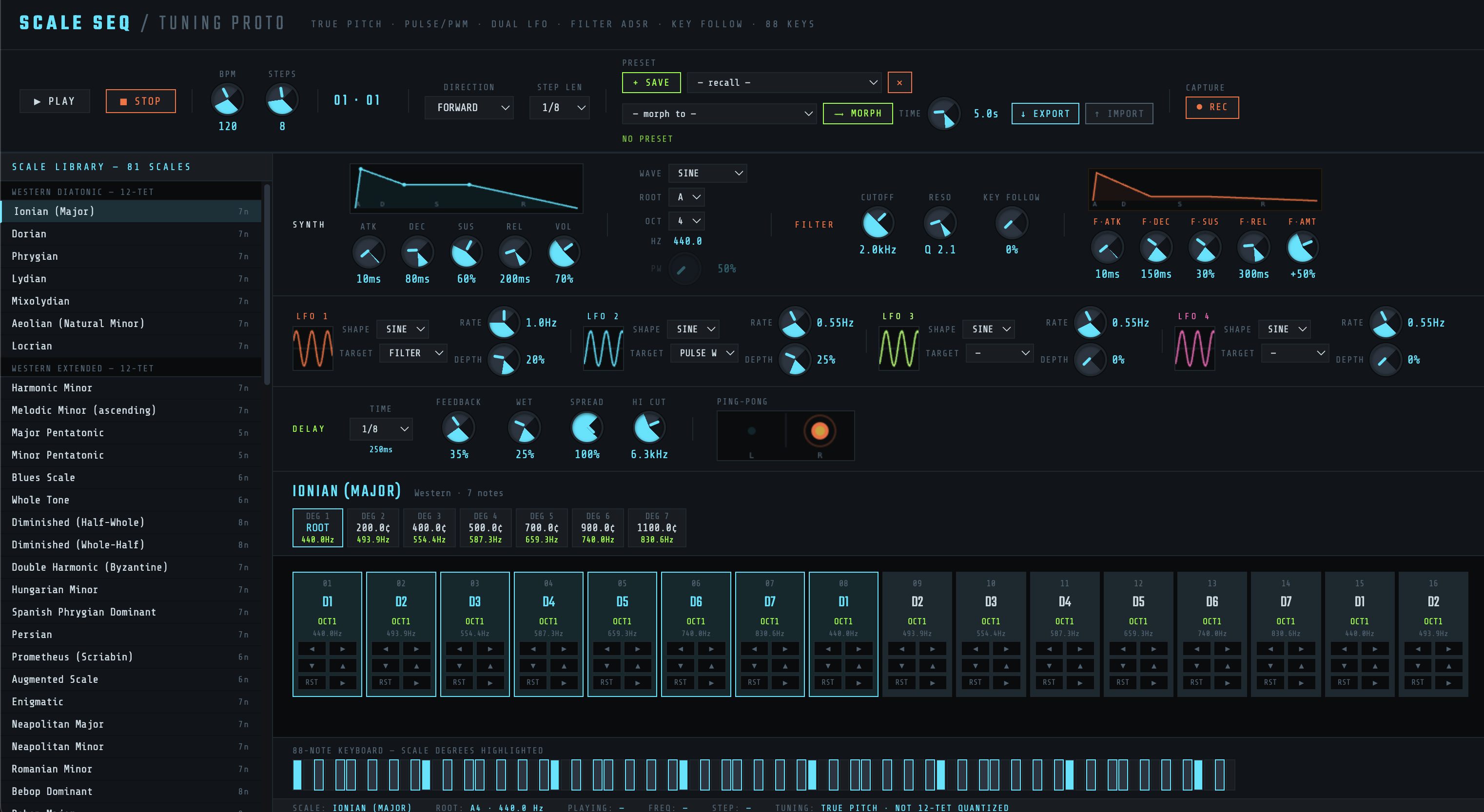
Scale Sequencer: ~2,000 lines of vanilla JS, Web Audio API synthesis engine with ADSR envelopes, dual LFOs, 256-harmonic Fourier PWM, Schroeder reverb, 80+ scale microtonal library. Early career: PHP, HTML, JSP, JavaScript, CSS. The plus sign is fully covered.
PMP or similar certification (plus)
CSM (Scrum Alliance, 2014–2028) + SAFe Scrum Master (2014). Twelve years of practice behind both.
The CSM is backed by 12 years of actual Scrum Master practice at scale. SAFe certification comes from the DigitasLBI/SunTrust engagement where I operated in a genuine PI-planning, ART-aligned enterprise environment — not a training course.
02 — The Build

The TPM who
reads the diff.

Active GitHub practice. Production deployed. Not portfolio pieces — working software.

Scale Sequencer / Tuning Module & Synth
Vanilla JS (ES2022) · Web Audio API · HTML5 · CSS3 · Zero Dependencies · PWA
github.com/rjvaleo/scale-sequencer → rjvaleo.github.io/scale-sequencer/
~2,000 lines of production JavaScript. Full synthesizer: 5 oscillator types including a 256-harmonic Fourier-series PWM generator, amplitude + filter ADSR envelopes, dual LFOs, 12dB filter with key follow, tempo-synced ping-pong stereo delay, cathedral-scale Schroeder reverb (6 comb filters, 2 all-pass diffusers, RT60 up to 30s). 80+ microtonal scale library. Full preset serialization. YAML CI/CD. 44 commits.
Web Audio API Audio DSP Zero Build Step Zero Dependencies PWA Ready GitHub Pages YAML CI/CD 44 Commits
Scale Sequencer interface screenshot

20 public repositories  ·  github.com/rjvaleo

03 — Proof of Method

Three situations.
One response pattern.

How I think. Select a scenario.

The feature just got bigger.

Mid-sprint. Product wants to add two more acceptance criteria to a story already in development. Engineering says it changes the estimate. The sprint goal is at risk.

Sprint Goal Risk Scope Change Stakeholder Pressure

→ Response

01
Stop the addition from entering the sprint without a decision. Surface it in the same breath it's raised — not in the next standup.
02
Quantify with Engineering: not "it might take longer" — actual estimate delta, specific story, what it bumps.
03
Give Product the options: accept as-scoped, defer the additions, or descope something else to make room. Tradeoffs, not a no.
04
Document the decision in Jira and note it in the sprint report. Leadership never hears this for the first time in a retro.
Lived version: at Eptura, standardized a change impact signal workflow that gave Senior Leadership decision-ready scope/timeline tradeoffs before mid-sprint changes were acted on — not after.

Engineering is waiting on a decision.

A story has been in-progress for 3 days. Blocker: a technical architecture decision requiring sign-off from a senior engineer in back-to-back meetings. Velocity is bleeding.

Velocity Risk Dependency Recoverable

→ Response

01
Flag it in the blocker log the moment I know — not at end-of-day. Three days already means this was late to surface.
02
Reach the senior engineer through a side channel — Slack, a 15-minute calendar hold. The goal is a decision, not a meeting.
03
If the decision can't happen today: identify what the developer can work in parallel. Velocity protection is routing, not waiting.
04
In retro: add a readiness check to Definition of Ready — architecture decisions resolved before a story enters sprint.
Lived version: at the stealth AI startup, daily war rooms cut blocker-to-resolution time significantly by creating a clear escalation path and making blockers visible before they compounded.

The integration partner missed the milestone.

A third-party partner was supposed to deliver an API update your sprint depends on. It's not there. Your release date is 11 days out.

Release Risk External Dependency Stakeholder Visibility

→ Response

01
Confirm the miss with the partner and get a revised ETA in writing. This is the timestamp for every decision that follows.
02
Assess what can complete without the integration. Stub the dependency if Engineering can build against a contract. Keep the sprint moving.
03
Brief Senior Leadership and Product with options: delay, descope, or accept technical risk. They decide — with information, not surprise.
04
Update the risk log. Add the partner's delivery reliability as a known risk for future planning. It already happened once.
Lived version: at Underline Communications, managed third-party partner deliverables and escalation paths across a 16-week SaaS build — external dependency management was a weekly practice, not a crisis response.
04 — The CTO Slide

What leaves your desk
the day I start.

This role reports directly to you. Here's what that means in practice.

Right now, you're asking:
From day one, the answer is:
Is that project actually on track, or "on track" until it isn't?
Your weekly report is decision-ready. Status, risk, options. Not a status theater slide.
Why does Engineering keep getting surprised by scope changes two weeks before a release?
Scope changes hit a change impact workflow before they hit the sprint. You see tradeoffs, not surprises.
Does anyone own the dependency between the partner API and our sprint?
Every dependency is logged, sequenced, and owned. Integration partners have a delivery record and an escalation path.
Can I get a weekly status update that doesn't require three follow-up questions?
One read. No follow-up questions. If it requires explanation, it wasn't written right.
Why is the backlog always a mess right before planning?
Backlog hygiene is a weekly practice. Stories enter planning execution-ready or they don't enter planning.
Will this TPM actually talk to engineers, or just run ceremonies?
I read diffs. I write code. I know what a failing test looks like and why the build is broken. Engineers notice.
05 — Track Record

Where this was
already done.

Real engagements. Real complexity. Real delivery.

Eptura
Senior Scrum Master / Senior Program Lead
Mar 2022 – Dec 2023 · Remote
Enterprise SaaS (workplace and asset management). Agile PMO core member supporting ~10 distributed teams across U.S. and India. Standardized Jira workflows and dashboards for a 30+ person org. Weekly CTO-adjacent leadership reporting.
35%+ delivery efficiency improvement · PI-aligned cadence · Scrum-of-Scrums across 10 teams
Understood.org
Senior Project Manager / Agile Delivery Lead
Feb 2019 – Mar 2020 · NYC / Remote
Brought in to rescue a distressed multi-year replatform (Sitecore → React + Contentful). Stabilized delivery through scope clarity, cadence reset, and proactive risk signaling. Primary POC for engineering leadership and executive stakeholders through full SDLC.
Distressed program rescued · Platform migrated · Full SDLC owned
Stealth AI Startup
Strategic Project Lead / Scrum Master / BA
Feb 2024 – Aug 2024 · Remote
Scrum Master across AI automation and data pipeline initiatives. Requirements elicitation, backlog management, daily war rooms. Re-sequenced delivery pipelines. SQL-level validation across delivery environments.
~30% reduction in data processing time · Proactive exec reporting
A&E Television Networks
Agile Coach & Senior Scrum Master
Mar 2016 – Feb 2018 · New York
SVOD R&D: History Vault, Lifetime Movie Club. Web, mobile, OTT/CTV. Coordinated 12–15 concurrent release streams across Engineering, UX, QA, and Content. Scrum-of-Scrums across 6 teams. Built Jira visibility from scratch.
12–15 concurrent streams · Multi-platform delivery · Jira build-out
DigitasLBI / SunTrust
Senior Scrum Master (SAFe)
Mar 2014 – Nov 2014 · Atlanta
SAFe enterprise delivery in a governance-heavy, compliance-aware financial services environment. PI planning, ART-aligned cadence, offshore QA coordination (Costa Rica). Audit-ready reporting.
SAFe · PI Planning · Regulated delivery · Offshore coordination
OVRSTCH
Founder / Product, Systems & Ops Lead
Sep 2024 – Mar 2026 · Remote
Self-directed product and operations venture. End-to-end pipelines across physical manufacturing, digital commerce, and fulfillment. Agile cadence, Jira tracking, AI-assisted planning. Proof that the delivery discipline isn't role-dependent.
Full-stack delivery ownership · Solo TPM · AI-integrated operations
06 — The Ramp

Day one.
Day thirty.

What walks in the door — and what gets built before the first month is out.

Day one.
What I walk in with
Delivery framework ready to deploy: risk log, release readiness checklist, dependency map, stakeholder communication cadence. None of this gets built on your time.
Jira discipline from day one. Dashboards configured, sprint health visible, velocity baseline started, burndown running.
CSM and SAFe Scrum Master credentials backed by 12+ years of actual Agile delivery across SaaS, media, enterprise, and regulated financial services.
Active software development practice. I read your engineering team's output the way a PM should — not just as tickets, but as decisions made in code.
20 years of pattern recognition for what's about to go wrong before it does.
Executive communication style already calibrated: direct, decision-ready, no noise.
Day thirty.
What I will have built
Every active project's critical path mapped. The two or three most fragile points identified and named — before they become incidents.
Integration partners contacted, delivery records reviewed, escalation paths documented. No more "who do we call when this breaks."
Project tracking that gives you full visibility without asking for it. One read per week. Decision-ready.
Names, working styles, and communication preferences of every engineer, designer, QA lead, and PM I coordinate with. Trust is built early or not at all.
The backlog in the shape it needs to be for predictable sprints. DoR enforced, acceptance criteria tight, no ambiguous stories entering planning.
Something shipped.

Let's get to work.

This deck shipped on time. So will everything else.

Richard J. Valeo, CSM
917-664-1750  ·  rjvaleo@gmail.com
"The TPM who can read the code, run the standup, brief the CTO, and still ship by Friday."